
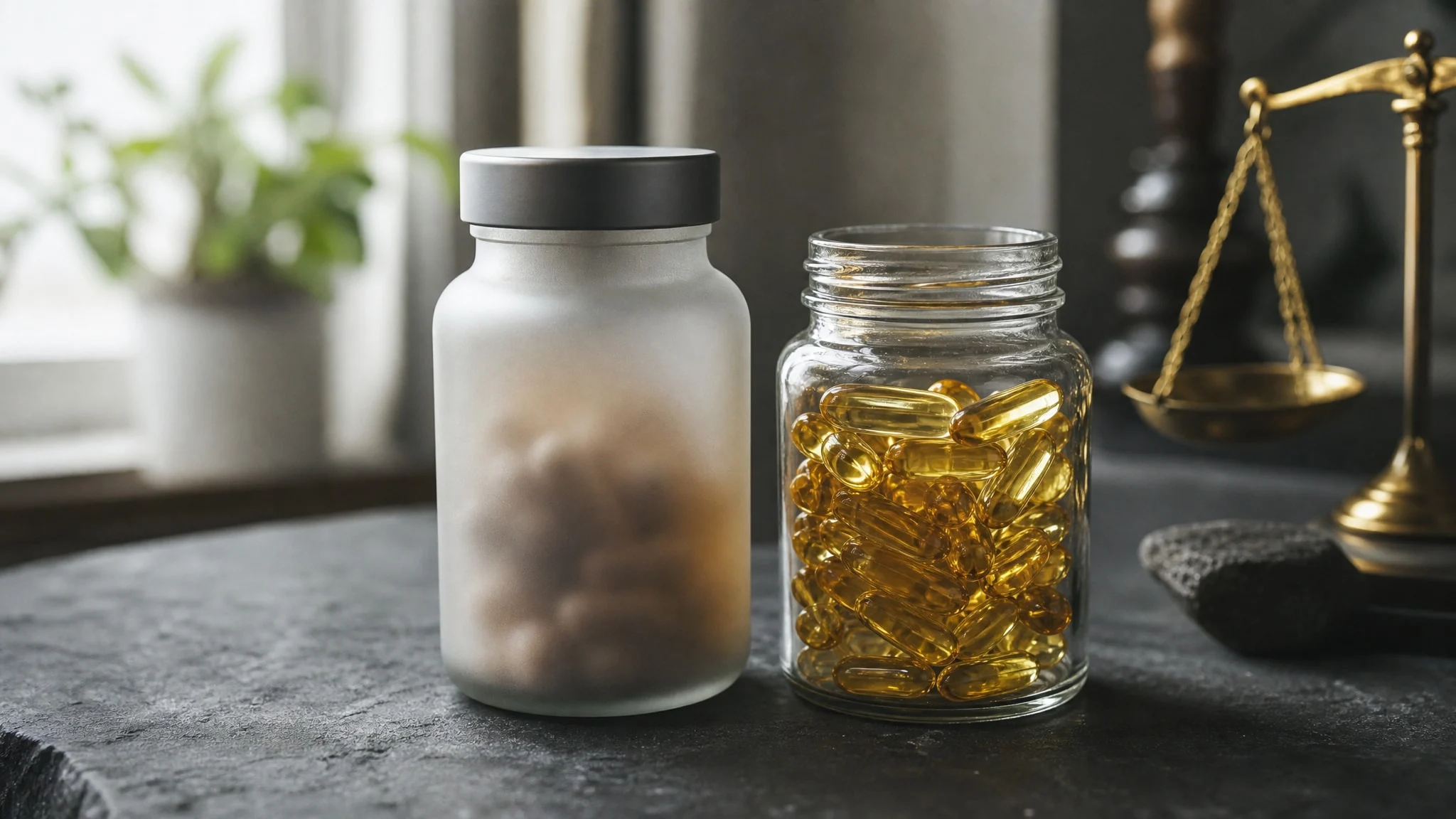
Buying supplements often feels like decoding a puzzle rather than making an informed choice. Ingredient lists promise metabolic support or restorative sleep, yet the actual quantities hide behind vague terminology. That vagueness protects the manufacturer’s margin, not your physiology. It isn’t accidental. It’s structural, designed to make comparison shopping nearly impossible for even the most diligent researcher.
Regulatory frameworks allow proprietary blends to protect trade secrets. But that loophole stops you from ever assessing whether a formula contains a therapeutic dose of a key nutrient or just a decorative trace of it. Understanding the difference between a proprietary blend and a fully labelled dose is the first step toward reclaiming control over your health regimen, and making sure you’re not paying premium prices for a formula that does nothing.
What Is a Proprietary Blend in Supplements?
A proprietary blend is a regulatory shield. It lets a manufacturer list the total weight of a group of ingredients without disclosing how much of each individual component sits inside that mixture. The practice is entirely legal. It also creates an information gap that stops you verifying efficacy against any established scientific standard.
You can’t validate a product’s potential benefits when the label hides behind collective nouns like “metabolic matrix” or “calming complex” instead of printing a precise milligram count for every active compound. Clinical studies on botanicals like ashwagandha and berberine consistently use specific milligram ranges to demonstrate efficacy, which makes an unquantified blend impossible to check against the literature. Without those exact figures on the label, you’re trusting marketing copy over measurable biochemistry.
The distinction matters because biology responds to dose, not presence alone. An ingredient can appear prominently in the blend’s name, suggesting it drives the effect, while actually making up less than one percent of the total weight. This labelling convention protects intellectual property, not you, leaving you to guess whether the product matches the research that convinced you to try it.
Why Brands Use Proprietary Blends to Underdose
Cost cutting drives most proprietary blend use in the supplement industry. It lets a company include an expensive active ingredient at a sub-clinical level, then fill the rest of the capsule with cheaper compounds. A “Sleep Support Blend” listing 500mg total could contain 490mg of cheap lemon balm and only 10mg of saffron extract, which renders the expensive active ingredient clinically useless despite appearing right there on the label.
The industry calls this fairy dusting. It lets a brand market a premium ingredient without paying to include it at an effective dose. You end up paying for the mention of a powerful botanical rather than its physiological impact, which defeats the whole point of supplementation. Compare a proprietary blend against a fully labelled dose and the financial incentive becomes obvious: full disclosure forces a manufacturer to commit to a costly ingredient ratio, with no room left to pad margins with inert bulk.
Clinically informed dosing demands a precision that proprietary blends prevent by design. If research shows that 300mg of a specific extract reduces cortisol effectively, but the blend provides only 800mg total spread across five ingredients, the maths doesn’t support the claimed benefit. We formulate every Balance product with fully disclosed ingredient quantities, because effective metabolic and stress support needs precise, clinically informed doses, and hidden blends can’t deliver that.
Hidden Supplement Fillers and Label Transparency
Opaque blending often hides more than an underdosed active ingredient. It can conceal synthetic fillers, flow agents and low-quality botanical extracts that add volume without adding value. A manufacturer might use magnesium stearate, silicon dioxide or maltodextrin to fill a capsule when the active blend is too small to occupy the full space, and these additives rarely get a mention on the front label.
Transparent labelling is the only reliable way to confirm a product contains pure, high-quality botanicals without unnecessary additives diluting the formula. When every ingredient and its exact quantity sits out in the open, there’s nowhere for a cheap filler or a degraded extract to hide. You deserve to know exactly what enters your body, especially when you’re managing something as sensitive as insulin response or neurotransmitter balance, where purity directly shapes the outcome.
Hidden fillers become a real problem when they interact with active ingredients or slow absorption in ways no clinical trial ever tested. Without full disclosure, you can’t cross-reference the full ingredient profile against a known contraindication or sensitivity. Real transparency treats the supplement facts panel as a complete inventory, not a curated highlight reel.
How to Read a Supplement Label for Clinical Efficacy
Reading a label critically means shifting your attention from the front-of-pack claims to the supplement facts panel, where the formulation actually lives or dies. Start by scanning for collective terms like “blend”, “matrix”, “complex” or “proprietary formula”. These signal grouped ingredients with no individual weights attached, and they’re an immediate red flag for underdosing.
Cross-referencing the milligram amounts on the label against established therapeutic ranges is essential for judging whether a product can realistically deliver its promised benefit for metabolic or stress support. If a label discloses 200mg of ashwagandha but the clinical consensus points to 300–600mg for a meaningful cortisol reduction, you’ve found the gap between marketing and medicine before spending a single rand. Our ashwagandha buyer’s guide breaks down these therapeutic thresholds so you can judge a product against peer-reviewed standards rather than an advertising budget.
Pay attention to the order ingredients appear in within any disclosed list too, since labelling rules typically require descending order by weight. If the most expensive or most researched ingredient appears last among several disclosed components, it likely makes up the smallest fraction of the formula, no matter how prominently it features in the product’s name. Reading a label with this level of scepticism turns you from a passive buyer into an evaluator who can tell genuine efficacy from clever packaging.
Underdosed Supplements in South Africa: What to Watch For
South African consumers face a particular problem here. Imported products may follow different regulatory standards to the ones enforced locally, and generic blends often lack batch-specific verification. Underdosed supplements sold in South Africa frequently come from regions with looser labelling rules, so a product on our shelves might not meet the potency its country of origin would demand.
Choosing locally manufactured products with batch-tested purity and potency guarantees is a real safeguard against that variability. When a brand formulates and manufactures within South Africa, it sits under direct oversight, which makes accountability faster and more traceable than dealing with a distant international supplier. You gain confidence knowing third-party testing checks every batch against the label claim, rather than relying on a certificate of analysis that might be outdated or irrelevant to the specific lot you bought.
Local production also protects freshness and stability in our climate, which matters for botanical extracts sensitive to heat and humidity in transit. An imported blend sitting in a shipping container or an unclimate-controlled warehouse can degrade before it reaches your door, compounding the dosing uncertainty already built into a proprietary formula.
Clinically-Informed Dosing vs Marketing Hype
Marketing hype runs on buzzwords and trending ingredients. Clinically informed dosing anchors itself in a physiological mechanism that needs a specific quantity to trigger measurable change. A product addressing insulin resistance, for example, depends on a precise berberine concentration to activate AMPK pathways effectively; anything below the researched threshold produces a negligible metabolic impact, however compelling the packaging looks. Our berberine supplement guide explains why hitting that exact target matters far more than simply listing the ingredient somewhere in the formula.
Real root-cause wellness needs an evidence-driven quantity, not a secret mixture that hides whether the formula lines up with the science. When a brand chooses storytelling over stoichiometry, it sells the idea of health improvement without giving you the biochemical substrate needed to achieve it. You can’t out-market human metabolism, and no amount of persuasive copy makes up for a formula that falls short of a therapeutic dose.
This approach doesn’t replace medical treatment or address an acute psychiatric condition that needs pharmaceutical intervention. It supports foundational physiological processes through nutritional biochemistry, which works on a different timeline and through different mechanisms to conventional medicine. Keeping that boundary in view keeps expectations realistic, and keeps supplementation as a complement to proper clinical care rather than a substitute for it.
Choosing Transparent Botanical Health Products
Choosing a supplement that respects your intelligence starts with demanding full disclosure of every ingredient and its exact milligram quantity. A brand committed to that standard shows confidence in its formulation by inviting scrutiny rather than hiding behind a protective labelling convention. When you’re weighing up herbal supplements for sleep, comparing a specific saffron dose against a synthetic alternative shows whether a product relies on a proven botanical or just borrows its reputation. You can explore that comparison in our article on herbal supplements for sleep, which shows how transparency makes real evaluation possible.
Balance holds open labelling and South African manufacturing as the baseline standard for trustworthy metabolic and stress support. Every product in our range displays its exact ingredient quantities, because your health decisions should rest on verifiable data, not on faith in a proprietary secret. Our transparent sleep and stress formulas put that philosophy into practice, with clinically informed doses you can check against the research yourself.
Check your own supplement cabinet today. Look for proprietary blends on every bottle and compare the disclosed doses against a clinical benchmark. Where you find a gap, replace that product with one that honours both the science and your right to know exactly what you’re taking.
[…] what enters your system and why each component sits at that specific strength. Our article on proprietary blend vs labelled dose supplements explains how hidden blends fail to deliver clinical results compared with open […]
[…] products often lack, so the formulation you researched is what actually reaches your bloodstream. Understanding proprietary blend risks matters if you’re tired of guessing games, and we invite scrutiny because our dosing holds up […]
[…] reach that window or just offer a sub-clinical dusting. Understanding the difference between a proprietary blend vs labelled dose explained is the first step in avoiding wasted spend on a supplement that was never going to […]
[…] expensive ingredients at sub-therapeutic levels, undisclosed. Knowing the difference between a proprietary blend vs labelled dose is essential if you want to judge whether a product can realistically deliver what it promises. […]